For parents · What to say when...
What to say when your child hates losing

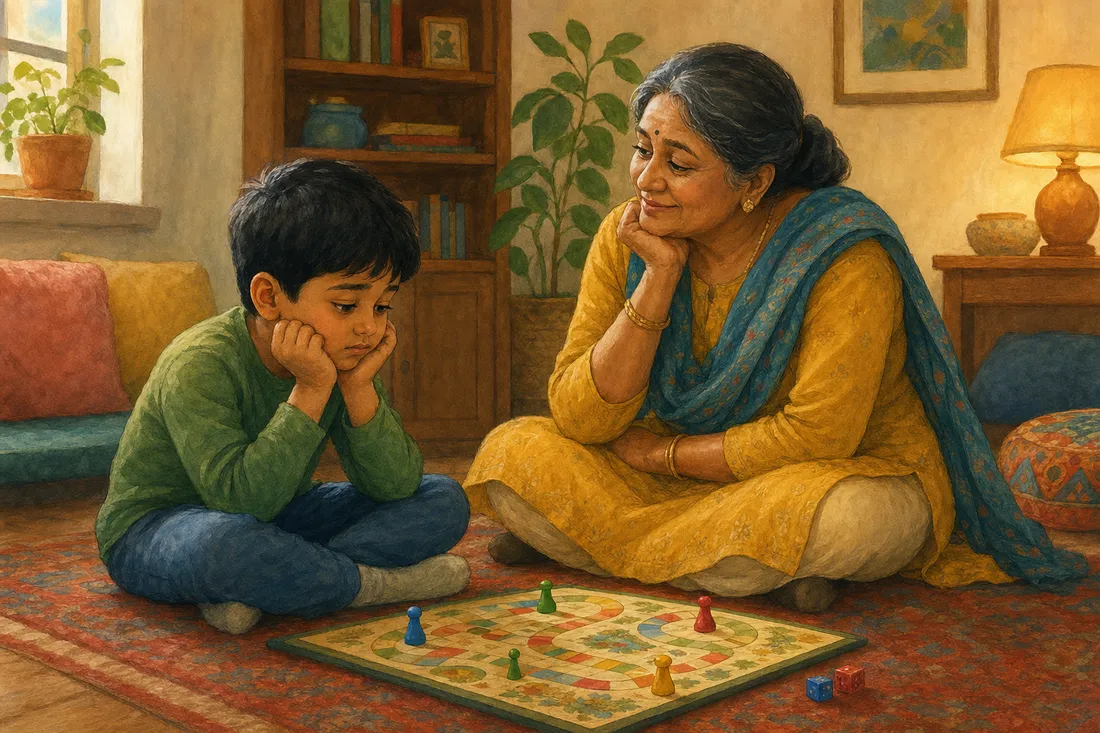
Short answer: Let the disappointment be real before you teach anything ("You really wanted to win, and you didn't. That stings."). Then move their pride from the result to the playing. How they played was theirs, whether they won wasn't fully. A child who learns to value a good game over a won one can come back and play again tomorrow.
Losing a game can undo a small child completely: the tears, the flipped board, the “I’m never playing again.” Winning feels like everything in the moment, and losing feels like proof of something. You can’t talk them out of caring. You can help them care about the right part.
What to say in the moment
- Let it sting first: “You really wanted to win. Losing feels horrible.” A child who feels understood settles faster than one who’s told it’s only a game.
- Praise the playing: “You made some clever moves there.” This quietly moves their pride onto the part that was theirs to control.
- Model an easy loss yourself: let them see you lose a round and take it lightly. “Ah, you got me. Good game.” Children copy the losing they watch more than the words they’re told.
The idea underneath
The Stoics loved an image for exactly this, and it was an archer. Cicero wrote that the archer’s whole task is to aim as well as he can. Where the arrow lands after that is partly the wind’s.
From the Stoics
To do all he could to aim straight… the actual hitting of the mark would be, in our phrase, to be chosen but not to be desired.
A good archer aims with care every time. Some arrows still miss, and that doesn’t make the aim wrong. A child can learn a kinder question to ask after a loss: “did I play well?” That one is theirs to answer, and often the answer is yes. That’s The Archer, a Stoic Sprout story about trying your best when the result is out of your hands.
What to avoid
- “It’s only a game.” True, and useless mid-tears. It tells a child their feeling is silly. Let the loss matter, then help them carry it.
- Letting them win to dodge the meltdown. A child can tell. And it robs them of the thing worth learning: that you can lose, be sad, and be perfectly fine.
The story for this
The ArcherFree to try
“Take care of your aim.”
Even when the wind moves the arrow, you can still aim well. A gentle look at trying your best when the result is out of your hands.
Hear the story → Mark made Stoic Sprout as a dad in Melbourne, for his own young children, with calm stories drawn from the real Stoic philosophers. More about Mark →
Small stories for big feelings.
Calm tales from the real Stoic philosophers, with a phrase your child can keep. A few are free to try.